Care for people operating under sustained physical and cognitive load.
Your body should support performance. Not quietly absorb strain.
Functional Performance Care · Sydney CBD
When the body starts
absorbing what the
mind refuses to show.
High performers rarely collapse suddenly. They erode quietly. Sleep gets lighter. Recovery takes longer. The edge dulls. You keep functioning — but the margin shrinks.
These are not signs of weakness. They are signs of a system operating beyond its recovery capacity — and they compound over time if left unaddressed.
Waking unrested. Light sleep cycles. The recovery that should happen overnight — isn't.
Tightness that doesn't release. A body braced — even when you're not under immediate pressure.
Training harder but adapting less. What used to take a day now takes three.
No reliable fuel curve. Afternoon crashes. Relying on stimulants to maintain output.
The system is full. Minor disruptions land harder than they should. Tolerance is eroding.
Nothing dramatic — just a low-grade wrongness. Hard to name. Impossible to ignore.
Can't fully switch off. The nervous system stays in drive even when the work stops.
Still performing. But the buffer is thinner. One bad week feels like it takes three to recover.
These signals don't mean something is broken. They mean your system is telling you something — and it hasn't been measured yet.
The Problem Is Rarely One Symptom
When stress accumulates, the nervous system, structure, recovery, and performance all start compensating.
Nervous System Overload
Chronic stress keeps your nervous system in a heightened state, affecting sleep, focus, recovery and resilience.
Structural Compensation
Poor posture, tension and imbalances place uneven load on your body, leading to discomfort and dysfunction.
Immune & Inflammatory Response
Ongoing stress and physical load increase inflammation and reduce your body's ability to repair and recover.

Poor Recovery Capacity
Stress, lack of quality sleep and constant demands leave your body under-recovered and running on empty.
Performance Decline
When the body is under stress and out of balance, movement efficiency, strength, endurance and mental clarity suffer.
Mental & Emotional Strain
The body and mind are connected. Physical stress drives mental fatigue, irritability and overwhelm.
Addressing the root cause, not just the symptoms, is the key to lasting change.
The Pressure Proof
Assessment.
Most professionals never get a clear picture of how their body is actually coping. The Pressure Proof Assessment changes that. It is a structured, 90-minute evaluation designed to measure exactly how your system is performing under the demands you place on it.
Not a general check-up. Not guesswork. A precise, system-level assessment that identifies your primary constraint — and tells you exactly what to do about it.
The Pressure Proof Assessment begins with a thorough chiropractic spinal examination — the structural foundation your entire system relies on.
The Pressure Proof Assessment maps how your nervous system and structure interact under load — revealing compensation patterns that are quietly limiting you.
The Pressure Proof Assessment measures how your system manages and recovers from stress — autonomic regulation, adaptive capacity, recovery margin.
The Pressure Proof Assessment evaluates how your body performs under real demand — movement efficiency, load tolerance, and output under pressure.
The Pressure Proof Assessment includes precise, targeted treatment based on what your evaluation reveals — specific to your system, not a template.
The Pressure Proof Assessment ends with re-testing — so you leave with objective data, a clear report, and a prioritised plan for what comes next.
You will leave the Pressure Proof Assessment knowing exactly how your system is performing, where the primary constraint is, and what to focus on first.
Real data.
Not a conversation
about how you feel.
The Pressure Proof Assessment uses clinical-grade testing equipment — the same tools trusted by the NFL, Premier League, and elite military units worldwide. Every result is objective, repeatable, and specific to your system.
This is not a wellness assessment. It is a precise, data-driven evaluation of how your nervous system, structure, and physiology are performing under the demands of your life.
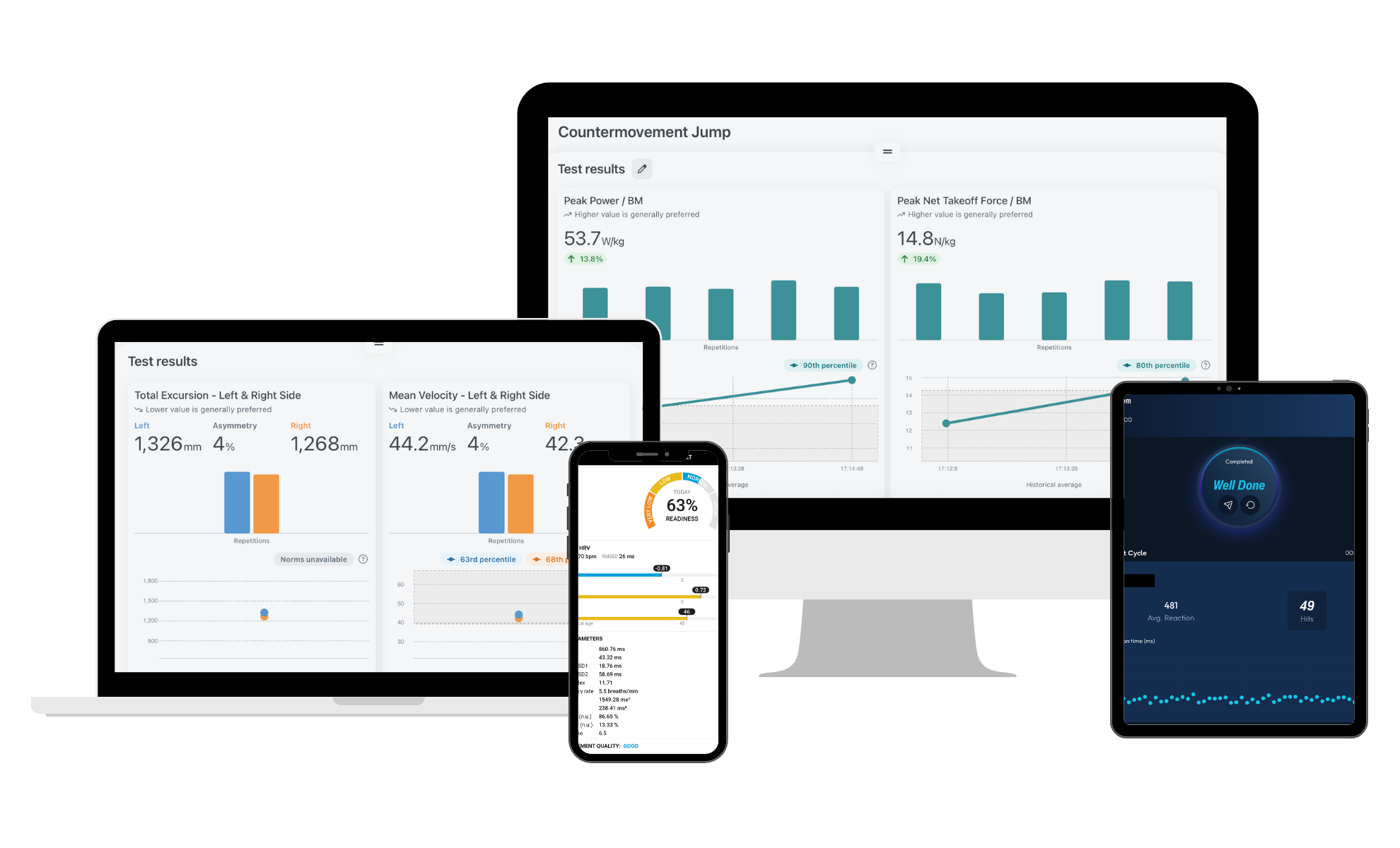
Objective results — repeatable and independent of how you felt that morning. The data doesn't rationalise. It measures.
Asymmetries, compensation patterns and neurocognitive decline rarely show up in how you feel. They show in the data.
With objective data across all systems, the single factor limiting your performance becomes identifiable — not assumed.
Baseline data means every future session shows exactly how your system has changed — measurable progress, not a feeling.
The same equipment used by the NFL, Premier League, and elite military. Now available for professionals who want to know exactly where their system stands.
Book the Pressure Proof AssessmentStop guessing.
Start knowing
exactly where you stand.
Most high-performers are managing symptoms, not solving problems. They adjust training, sleep more, change supplements — and the decline continues, because they never measured what was actually changing.
Stability precedes scalability and sustainable performance. You cannot optimise a system you haven't measured.
Certainty
You'll know — with objective data — exactly how your body is adapting to the demands you place on it. Not a rough idea. Not a gut feeling. A structured, system-wide picture across every key domain.
"Now I know exactly how I'm tracking. This confirms what's working and what's not. I'm not guessing anymore."
Clarity
One primary constraint identified. The single factor that is limiting your performance right now — not a list of things to work on, not general advice. The highest-leverage change, clearly defined.
"This is the priority. This is what's been holding me back. I can stop wasting effort on things that don't matter."
Control
Confidence that your body can sustain what you're asking of it — without being blindsided by fatigue, injury, or a loss of edge. Ahead of the problem, not reacting to it.
"My body can handle what I'm asking of it. I'm ahead of this, not reacting to it. I'm not going to get caught out."
Removing pressure is rarely realistic. Improving tolerance and recovery efficiency is. That is what this assessment delivers.

Twenty years.
One focus:
removing the guesswork.
Ryan Day works with executives, founders, and high-performing professionals who are still performing — but starting to notice the signs. Not a dramatic breakdown. A quiet, measurable decline. In energy, recovery, resilience, and edge.
His work is not about fixing what is broken. It is about measuring what is changing before it becomes a problem — and giving you the structured, data-backed clarity to act on it precisely.
Symptoms often reflect accumulated load — not structural fragility. The system is coping. The question is, for how long.
Treatment should reduce long-term physiological cost, not create dependency. The goal is a system that runs cleaner under pressure.
Recovery capacity determines long-term resilience. This is what the assessment measures — and what the plan is built to protect.
Not a job title.
A standard
you hold yourself to.
This practice is not defined by industry or seniority. It is defined by the standard you hold yourself to — and the fact that you're starting to notice that standard is harder to maintain.
If you perform at a high level, train consistently, and value data over guesswork — this assessment was built for you.
They train regularly. They manage their sleep. They've tried adjusting their routine. But the decline continues — because they've never measured what was actually changing.
They don't need to be told to rest more or stress less. They need to know exactly where their system is losing ground — and what to do about it with precision.
Ages 30–55 · Men and women · Sydney CBD
This is a limited-availability practice. Not everyone is the right fit.
The Pressure Proof Assessment is where that decision is made. First 10 clients at founding rate — $600.
Most care manages
symptoms. This measures
the system.
There is no shortage of practitioners who will ask how you're feeling, give you general advice, and book you in next week. That is not what this is.
The Pressure Proof Assessment is built on the principle that you cannot improve what you have not measured. Every decision is grounded in objective, clinical-grade data — specific to your system, at this point in time.
Removing pressure is rarely realistic. Improving tolerance and recovery efficiency is. That is the focus here.
Clinical-grade equipment used by the NFL, Premier League, and elite military. Every result is repeatable, independent of how you felt that morning, and specific to your system.
Subjective and objective data across all key domains combined into one structured profile. Not a list of separate readings — a complete picture of how the system is coping.
One primary constraint identified. One prioritised action plan. Not twenty things to try — the highest-leverage change, clearly defined and immediately actionable.
Baseline data means every future session shows exactly how your system has changed — not a rough sense of improvement, but a measurable, comparable result.
"This is not a wellness assessment. It is a precise, system-level evaluation of how your body is performing under the demands of your life."
20 years clinical experience. AHPRA registered. Published research in stress physiology and mind-body health.
Stop guessing.
Know exactly
where you stand.
A 90-minute in-clinic assessment and 30-minute debrief that gives you a complete, objective picture of how your body is adapting to the demands of your life — and the single highest-leverage change to make next.
Experience
Assessment
Streams
Constraint
Chiropractor

Regulate. Recover. Perform.
Functional Performance Care for leaders, founders, and high-performing professionals who want to know exactly how their system is coping — before small declines become larger problems.
Pre-booked appointments only. Limited availability. International consultations available on request.
New Patient Inquiry